My story
I make software that turns a floor plan into a room you can buy. I have been starting companies since I was eighteen, usually before the evidence: three closed, one sold, one running. The one before Decato was Empy, an AI that coached people during work calls, and most of this page is about it.
Between 2022 and 2026 I tried twelve times to ship a product. I went through eleven co-founders. I did about two hundred investor calls over Zoom. I spent $40,000 of my own money, which was everything I had saved at Google, and $155,000 of other people's. Over those four years the company earned under $15,000. I finished with $11,000 of debt.
I can tell you what each of those bought. That is the only reason to list them.
Where I came from
I was born in Moscow. My parents had left Armenia in the nineties, the way people left then, which is to say because of hunger. My father worked, and eventually had a shopping centre and a row of market stalls. I grew up in the calm that bought.
My first words were Armenian and I barely spoke Russian before school. Russian came second and it is the language my conscious life happened in, which is why it is also the language in which I still feel I have to earn the right to talk.
I spent most of my life assuming I would be the first person in my family to do anything difficult. At thirty I found out about a cousin who left for America at eighteen, cleaned a petrol station, and is a professor now. And about a great-uncle who took an engineering degree in Iran in the sixties and built the infrastructure of the north of the country. I was not the first. I was late.
The other thing I inherited was a way of getting through things sideways. I learned early, in school, that you do not have to take the direct route: you can be clever, be liked, negotiate, do the minimum and not fail. It worked, so it stopped being a tactic and became the way I live. Anything that required doing one thing at a time and being answerable for the result frightened me out of all proportion.
I have almost no memory of myself between eleven and seventeen. What I remember is games. In a game the goal is stated, the rules hold, and things end. It was the only place where finishing was not dangerous. I wrote custom maps for Warcraft III, which is not playing: you write the rules and other people live inside them. Everything I have built since is a system of rules for a messy human situation. That sounds like a calling. It is also the shape of the problem.
Ten years on other people's budgets
I started selling at eighteen: a small digital agency, websites and marketing, run while I was still at school and through university. An ad agency at twenty-one, over $4,000 a month, closed within a year. A first technology startup at twenty-three that closed, and two full-time jobs afterwards to clear what it left behind.
Then a decade inside other people's companies. Performance marketing at adidas from 2014. Product marketing at Artec 3D. A product marketing team in Singapore at Cryptology. Krisp. Product at inKin. And from July 2020 to November 2021, analytical consultant at Google, working with Semrush, Miro, Veeam and Wrike across the US, Europe and Asia.
I was good at other people's growth long before I was any good at my own. That decade is the reason I can build a go-to-market on my own now, and it is also ten years of not doing the thing I said I wanted to do.
July 2022
It did not start with an idea. It started with a person.
At a retreat in Armenia one man in the group could not be in contact: he interrupted, he fidgeted, he pulled the room apart, and everyone had written him off. He simply did not know how to be with people.
We talked for hours. I showed him how he sounded, where he left, what the others felt. He saw it for the first time — not understood it, saw it. The group changed that evening and so did he.
I decided I wanted more people to be able to do that. That is the thing I can do reliably. It does not scale, which turned out to be most of my problem.
Four years putting it into software
Empy was the attempt. The premise was narrow enough to be testable: most damage in a conversation happens when someone states a conclusion as though it were an observation. So we fine-tuned a transformer to tell the two apart in written speech, and got it to 91% F1.
At the same time, from 2021, I spent two years in the psychoanalysis master's at the Higher School of Economics. I did not finish it; the programme required attending in Moscow in person. But for those two years it ran alongside training a model to tell evaluation from observation in speech, and the two turned out to be the same problem.
Then three forms, each a different bet on who would pay. A Slack bot that watched team communication. A macOS application that ran during live calls and surfaced talk-time balance, engagement, unmet needs and the questions being asked. And in parallel, a sales motion into companies.
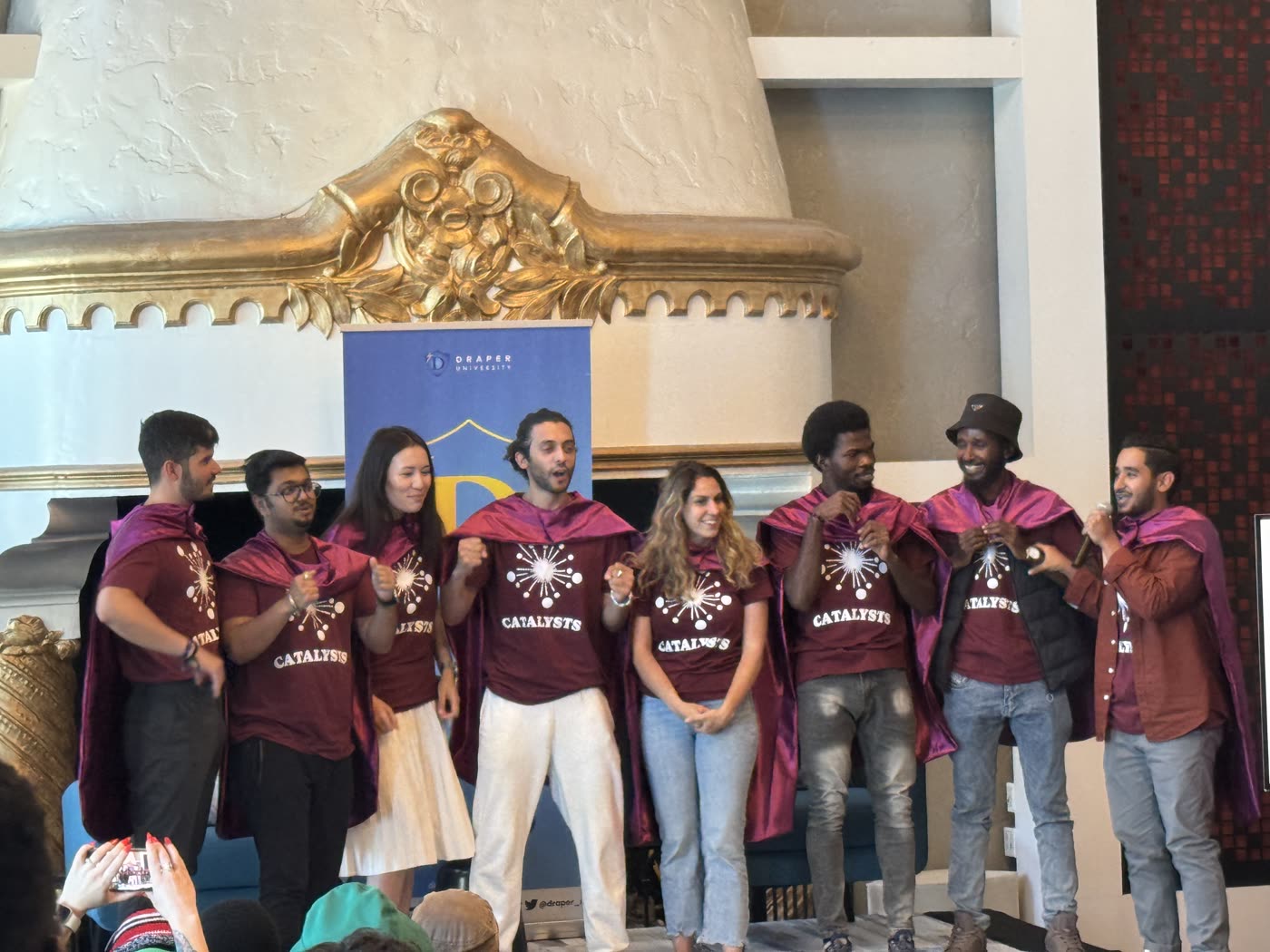
Four thousand people used it. Forty-three companies came through pilots and subscriptions, including seven US enterprise pilots, one of them into an organisation of over six thousand employees, with Erickson Coaching International and Facility Solutions Group among them. We raised a pre-seed, came second product of the day on Product Hunt, went through Draper University's Startup Hero programme in 2024 and Plug and Play Armenia, and were one of nine finalists at Burning Heroes in San Francisco, which meant pitching live at Plug and Play Silicon Valley.
The Electron client crashed enough to cost retention. I rewrote it in Swift in February 2026. That fixed the crashes and did not fix the business, and I closed the company in May.
I wrote the diagnosis down in December 2025, five months before I closed the company, and it is the most useful thing I own. For most of those four years I thought my problem was execution. It was not. I was building a mission instead of a product. A mission lives in the future, so it can never be shown to be wrong. When there was no revenue I said I was not in it for the money. When there were no users I said the market was not ready. Every month I found an intelligent reason the result had not arrived yet. We sold air and called it the future, and we believed it.
The business I did not take seriously
The whole time, I was running something that worked, and I kept forgetting to count it.
Four-day residential communication programmes for senior managers in technology: nonviolent communication workshops, morning practice, movement and group work, at $1,700 a head. Fourteen of them between 2020 and 2024. More than three hundred people trained. $70,000 in one six-month stretch. Across the same years it earned about five times what the software did.
I treated it as a side effect, because it did not look like the thing I wanted to be. That is a bad reason, and it cost me most of a decade. I wrote the question down myself, at the start of this year, and it is the shortest version of everything above: am I willing to build a product that does not look like my identity?
Decato
Now I build Decato with Vladimir Borisov, who was ML lead at Grid Dynamics and founded Fringe, an AI studio that shipped more than ten products.
A floor plan goes in. A finished room you can actually buy comes out: real products, real dimensions, real prices, assembled into a specification a supplier can quote. Designing a room takes an afternoon. Everything after it takes a week, because the floor-plan app, the mood board, the render, the budget spreadsheet and twenty retailer tabs do not know about each other, and a person becomes the integration layer between them at designer rates.
The hard part was never the image. Pretty is easy; any model will hand you a nice render. Real means the room is measured, the product exists, it fits, and it can be ordered — and that part is unglamorous, so almost nobody builds it. We shipped on 13 August 2026, and the launch split our users in a way we had not planned for. How it happened, in order, is on the Decato page.
Fifty people have used it. The first session averages six hours. One customer in the US pays for it. Those numbers are small and I intend to keep publishing them. Last checked 5 September 2026.
Three languages
I think in Russian for analysis and in English for action. English arrived late and consciously, and it is the version of myself I wanted to become: clearer, more structured, easier to sell in. Armenian is the root. I barely used it for years, so it still comes with constraint — and it is still the only one of the three in which I feel entirely myself.
Which is a reasonable description of the whole thing. I am better at seeing than at doing, and I have known that precisely since December 2025. I have been correcting for it since, deliberately, with a list.
The long version is in writing, put down while it was happening. Dates, schools and jobs are in the press kit, and what I have built is in projects.